Your cart is empty


Santa Maria (15th century)
Christopher Columbus' three-masted carrack, the Santa Maria was the flagship of his first, landmark voyage.
History
Grades 1 – 12
Keywords
mozaLink
/Weblink
Questions
- What is the name of the agreement that divided the world between the Spanish and the Portuguese kings?
- Where did Christopher Columbus come from?
- After whom was the New World eventually named?
- Which one of these plants does NOT originate in the New World?
- Which one of these plants originate in the New World?
- Which of these statements is true for the indigenous people of the Americas?
- Is the following statement true? One consequence of the Treaty of Tordesillas was that Portuguese is spoken in Brazil.
- How many ships did Christopher Columbus have on his first 'Indian' voyage?
- What was the name of Columbus's flagship?
- Which of these was not one of Columbus's ships on his first voyage?
- Is the following statement true? Colombus called the indigenous peoples of the Americas Indians, based on his misconceptions.
- What did Columbus call the indigenous peoples of the Americas, based on his misconception?
- Where did Christopher Columbus land for the first time in the New World?
- Is the following statement true? Christopher Columbus soon realised that he had discovered a new continent.
- How many times did Columbus travel to the New World?
- What position did the Spanish royal couple offer to Columbus?
- On which ship did Columbus return from the New World?
- Is the following statement true? In April 1492 the Spanish royal couple authorised the Indian expedition.
- Where was Christopher Columbus born?
- When did Christopher Columbus live?
- Is the following statement true? The Italian word 'colombo' means pigeon.
- Which country did Christopher Columbus want to reach by ship (sailing westwards)?
- Is the following statement true? Columbus was living in Portugal between 1476 and 1485.
- Is the following statement true? In April 1492 John II of Portugal authorised the Indian expedition.
- Is the following statement true? Christopher Columbus lived the rest of his life in Spain in great honour.
Scenes

Santa Maria
Columbus's flagship
On his first voyage (1492–1493) Christopher Columbus crossed the Atlantic Ocean (towards America) with three ships, two smaller caravels (Nina and Pinta), and the flagship, Santa Maria, a carrack (Columbus used the term 'nao'). The original name of Santa Maria ('Holy Mary') was La Gallega ('The Galician'), probably because the wood (oak and pine) used for the construction of the ship came from the Galician forests. Her owner (and captain at the same time) was Juan de la Cosa.
The three-masted carrack was approximately 25 metres long and 8 metres wide; her carrying capacity was between 180 and 240 tons. The ship did not return to Europe, she ran aground near Haiti and was damaged beyond repair.
Columbus's voyages were supported by the Spanish royal couple, and he travelled in representation of the Christian world, as shown by the ensigns and symbols on the ship.
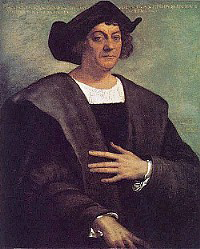
Christopher Columbus

Top view

Construction
- main mast
- crow's nest
- ropes
- stern mast
- stern sail
- stern
- rudder
- mainsail
- hull
- bow
- bonnet
- bowsprit
- foremast
- sail crossbar
- anchor
- deck
- topsail
- flag
Shape and structure of the carrack
The carrack was a Portuguese sailing ship used for both military and commercial purposes in the 15th–16th centuries.
It was a popular ship type, it quickly spread all around Europe. This ship type (called 'nao' in the 15th century) was constructed with two (or more) decks. The hull was not slim (generally 25–30 metres long and 8–10 metres wide); the bulging hull was narrowing upwards and downwards.
Carracks had a clipper-type bow and a transom stern. In the bow, there was a smaller, triangular superstructure, while in the stern a high superstructure could be found with more decks.
This type used to be constructed with two masts, then later with three. The mainmast in the middle of the hull and the foremast found in the bow were square-rigged, while the small mast in the stern was Latin-rigged. The topsail at the top of the mainmast (above the crow's nest) and the bonnet below the foremast also appeared in the carrack.

Animation
- ballast - Its function is to counteract the effects of weight above the water level. The keel also provides ballast.
- steerage - The part of the ship between the two decks. It contained the sailors' sleeping quarters, as well as part of the cargo and the equipment.
- deck
- cargo
- food/water
- helm
- Commander's cabin
- Niña
- Pinta

The first voyage of Christopher Columbus
- Palos, 3 August 1492 Departure from Spain (Niña, Pinta, Santa Maria)
- Bahamas 11–12 October 1492 Arrival in America
- Hispaniola, 24–25 December 1492 The Santa Maria wrecked
- Lisbon, 4 March 1493 Return to Portugal (Niña) Palos (Spain), 15 March 1493

Escort ships
- Niña
- Pinta

Cutaway
- ballast - Its function is to counteract the effects of weight above the water level. The keel also provides ballast.
- steerage - The part of the ship between the two decks. It contained the sailors' sleeping quarters, as well as part of the cargo and the equipment.
- deck
- cargo
- food/water
- helm
- Commander's cabin
Narration
The sailing ship Santa Maria was the flagship during Christopher Columbus' first voyage. La Gallega, that is, 'The Galician', was the original name of the ship that rose to fame through the landmark journey of 1492. The name probably originates in Galicia, Northern Spain, where the ship was built. The owner of the ship was Juan de la Cosa. It was a three-masted carrack, approximately 25 metres long and 8 metres wide with a cargo capacity of 180–240 tons. The squarish, capacious carrack is a Portuguese ship type that was used for both merchant and military purposes.
The deck consisted of several levels. During Columbus's voyage, the crew numbered 26 (including the discoverer of the New World and the owner).
Unfortunately, the Santa Maria, sailing under the Spanish flag, did not survive the world-famous journey. The ship ran aground near Haiti on Christmas Day in 1492.
Out of the fleet of three ships on the first voyage, Columbus then appointed one of the caravels, the Niña, as flagship, and returned to Spain aboard her the following year.