Your cart is empty


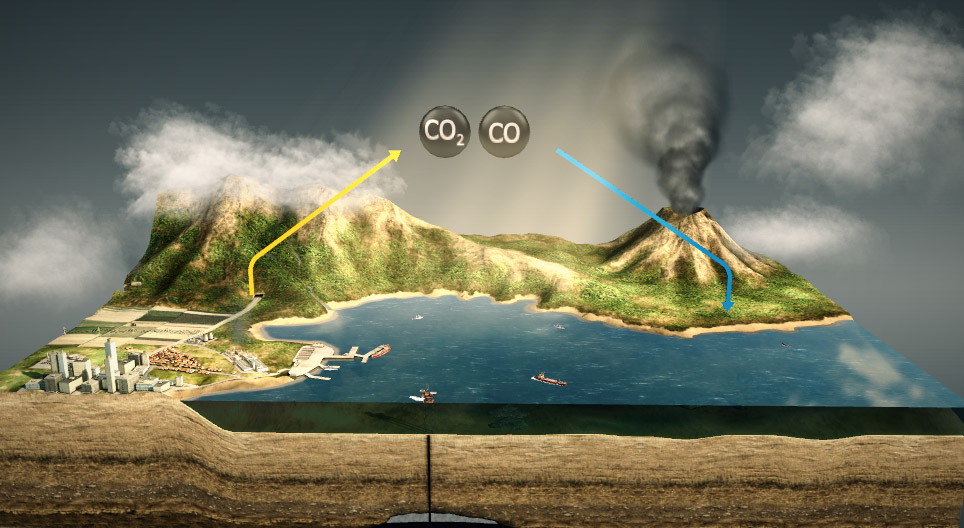
Carbon cycle
Carbon is bound in organic substances during photosynthesis, while during breathing, it is released into the atmosphere.
Geography
Grades 5 – 12
Keywords
mozaLink
/Weblink
Scenes

Carbon cycle
- emission
- binding
- storage
Definitions of terms:
Carbon: a chemical element with symbol C and atomic number 6. Carbon is known and has been used since antiquity. In nature it occurs both in its elemental and chemically bonded forms.
Most of carbon is found in bonded form as carbonate mineral (e.g. limestone, magnesite, dolomite). In water it is present as dissolved carbonate and bicarbonate. Natural carbon is mostly organic.
Coal is not an elemental carbon but rather a diverse mixture of carbon compounds. Crude oil and natural gas are primarily made up of various hydrocarbon compounds. A diamond is a carbon arranged in a crystal structure found in volcanic rocks. Carbon dioxide is present in the atmosphere in large amounts. Carbon is also a component of the organic matter of living organisms.
Photosynthesis: the life processes inside plants, algae and certain bacteria that convert inorganic matters into organic matter by the light energy from the Sun.
Autotrophs: organisms that produce organic compounds from inorganic matter (carbon dioxide, water, ions). Autotrophs include plants, which utilise atmospheric carbon dioxide by photosynthesis.
Heterotrophs: living organisms that obtain organic matter to produce their own organic matter. Heterotrophs include the kingdoms of Animalia and Fungi.
Greenhouse effect: the retention of heat in the atmosphere. Solar radiation is re-radiated from the surface into the atmosphere. A part of the re-radiated energy cannot escape the atmosphere since a 'wall', the atmospheric greenhouse gases, do not let it escape. This energy portion is therefore re-radiated to the planetary surface.
Without this phenomenon the average temperature on Earth would be around 40 °C cooler. Due to human activities, carbon dioxide levels increase, which contributes to greenhouse gas emission and may cause global warming.

Fast carbon cycle
- combustion
- photosynthesis
- CO₂ emission
- ingestion
- breakdown
- few days – tens of thousands of years

Slow carbon cycle
- volcanic activity
- acid rain
- runoff
- formation of coal and hydrocarbons
- breakdown of corals and plankton
- breakdown
- carbonate rocks
- magmatism
- CO₂ emission
- plate tectonics
- millions of years

Human intervention
- traffic emission
- industrial emission
- burning coal and hydrocarbons
- soil erosion
- photosynthesis
- agricultural emission
- forest burning
Narration
The number of chemical elements on the Earth is relatively constant, but their distribution and migration are changing both in the short and long terms, as a result of natural processes and human activities. In nature, substances are in a constant cycle, they undergo various changes and take on various forms.
Carbon is one of the most abundant elements on the Earth, it is a component in the atmosphere, rocks and living organisms. The carbon cycle is a complex process, as carbon is present in all living organisms.
Carbon is also present in significant amounts in the non-living environment, such as in carbonate rocks, in fossil fuels, in the atmosphere, in decomposing organic matter and in the hydrosphere.
The carbon dioxide content of air supplies living organisms with carbon. Autotrophs, organisms which can use atmospheric carbon, can fix carbon using the energy of sunlight and convert it into organic substances. This is the process of photosynthesis.
The substances in the carbon cycle may leave the cycle for periods of varying length. Dead animal and plant matter is broken down by organisms that decompose it. Most of its carbon content is released into the atmosphere as carbon dioxide, while some of it is transformed into carbonate compounds and dissolved in seawater.
In the soil, organisms break down organic matter, and humus compounds are produced and accumulated. Organic matter may turn into coal and hydrocarbons if their decomposition is inhibited for a period measurable on a geologic time scale.
Living organisms convert a part of their carbon compounds into carbon dioxide, which they release into the air. This is the process of breathing. The carbon re-entering the air therefore becomes a carbon source for plants again.
Other factors, such as volcanic activity, combustion, the decomposition of dead plants and the weathering of rocks also play a role in the carbon cycle.
Human activity also has an impact on the carbon cycle. Therefore the amount of carbon dioxide produced by the burning of wood, coal and petroleum and by the transport and industry sectors is substantial.
These activities affect the balance of the Earth's ecosystem, since increasing carbon dioxide levels contribute to greenhouse gas emissions and lead to global warming.