Your cart is empty


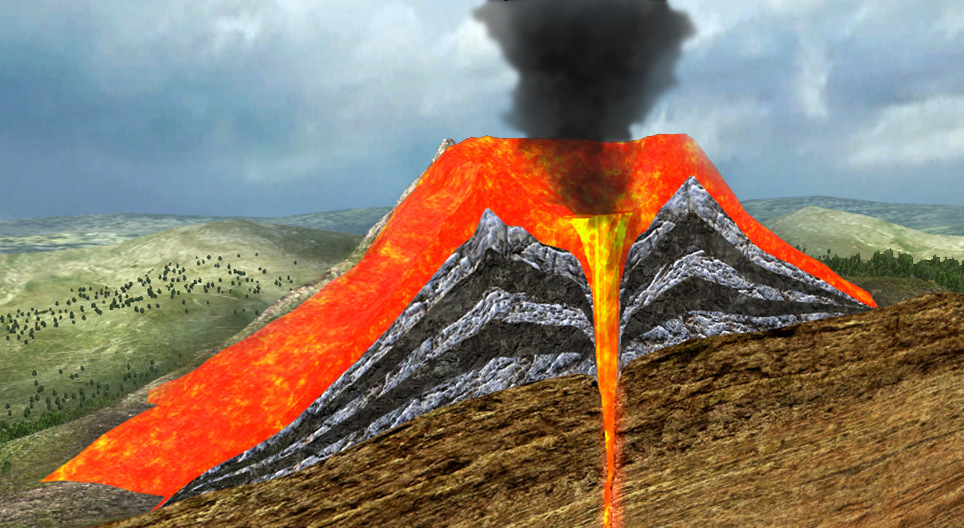
Formation of stratovolcanoes
Stratovolcanoes consist of layers of volcanic ash, debris and lava.
Geography
Grades 1 – 12
Keywords
mozaLink
/Weblink
Scenes

Stratovolcano
Inside the Earth's body, in the asthenosphere there is flowing hot molten stone, called magma; it collects in magma chambers in certain places. If the crust above these chambers is broken by fractures, hot steam and gas may escape towards the surface and erupt. Rock layers that get in the way are broken to pieces and pushed out, while combustible material is burnt.
Ash and debris fall back on the surface and form pyroclastic rock, called tuff (basaltic, andesitic or rhyolitic).
Due to the sudden release of pressure the hot magma stored underneath is pushed upwards. The eruption of the magma creates a crater, then the lava flows down the slopes. It burns everything that gets in its way, then it slowly starts to cool down.
The lava then becomes volcanic rock (basalt, andesite or rhyolite). This process starts again after some time (maybe decades) of inactivity. Repeated eruptions build up several layers of debris and lava, thus, a stratovolcano is formed.
Steps of the stratovolcanic activity:
1. A fracture appears in the crust
2. Eruption of hot steam and gases
3. Eruption of ash and debris
4. Lava flow
5. Inactive period
6. Repeated eruption of steam and gases, etc.
Definitions of terms:
Magma: Hot, viscous, high-pressure molten rock in the asthenosphere, mainly composed of silicates and dissolved gases.
Lava: Magma forced onto the surface by a volcanic eruption. Gases escape, then it cools down and solidifies.
Volcanic ash: pulverised volcanic rock containing volcanic debris, expelled into the air by a volcanic eruption and transported by wind over very large distances.
Conduit: a vertical pipe in the Earth's crust, through which magma gets from the magma chamber to the surface.
Crater: The wide 'throat' of the volcano's conduit, widened by the erupting volcanic material and raised by the flowing, solidifying lava.
Stratovolcano: A volcano formed by periodic volcanic activity. Volcanic debris and lava are alternately and repeatedly deposited on the surface, forming a volcanic cone.

Active volcano
- magma
- fracture/crevice
- conduit
- gas, steam
- ash, dust
- debris
- caldera
- lava
- solidified lava
- ash and debris

Structure of stratovolcanoes
- magma chamber
- conduit
- caldera
- solidified lava
- volcanic debris
Narration
During volcanic activity first vapours and gases erupt, then rock fragments. The size of the fragments ranges from a few millimetres to several metres. In the next phase, lava erupts and in a while it solidifies on the surface.
In the vicinity of the crater, the solid material collapses, forming a cauldron-shaped depression. This depression makes it possible for the volcano to erupt again in the same location.
One feature of stratovolcanoes is that eruptions occur periodically. That is, a layer of rock fragments and ash is followed by a layer of lava, which is covered by another layer of rock fragments and lava during the next eruption. This process is repeated several times. The resulting volcanoes can be several thousand metres high. They are typically symmetrical in shape, with the diameter of the crater reaching several hundred metres.